Trade: Canada vs. Republic of Ireland - More Markets
Resolution criteria on PolyGram: More markets for the FIFA International Friendlies game, scheduled for June 5 at 7:30 PM ET.
PolyGram is an on-chain prediction market where you trade YES or NO outcome shares with real USDC on Polygon. For this market, buy YES if you believe the event will happen, or NO if you think it won't. Your maximum loss is your stake — winning shares pay $1.00 each at resolution. Unlike sportsbooks, there is no house edge: prices are set by supply and demand from other traders and reflect the crowd's real-time probability.
- Liquidity
- $1K
- Total Volume
- —
- 24h Volume
- —
- Open Interest
- —
Market outcomes
| Canada (-1.5) | 42% YES | 59% NO |
| Republic of Ireland (-1.5) | 41% YES | 59% NO |
| Canada (-2.5) | 38% YES | 63% NO |
| Republic of Ireland (-2.5) | 38% YES | 62% NO |
| O/U 0.5 | 62% YES | 38% NO |
| O/U 1.5 | 53% YES | 47% NO |
| O/U 2.5 | 52% YES | 49% NO |
| O/U 3.5 | 48% YES | 52% NO |
Market context
Canada and the Republic of Ireland will meet in a FIFA International Friendly on 5 June 2026 at 7:30 PM ET. The current order book on Polymarket reflects a 41% implied probability for additional markets to be created around this fixture, suggesting traders are pricing in moderate uncertainty about whether supplementary betting options will materialise beyond the primary match outcomes.
Historical precedent shows that friendly matches between nations outside major tournament windows attract variable market depth depending on the teams' profiles and timing. Canada's recent competitive fixtures—including World Cup qualification campaigns and Gold Cup participation—have generated consistent trading interest, whilst Ireland's friendly schedule typically sees lighter volume unless the opponent carries significant profile. The current 41% probability sits between the extremes of certainty, indicating the market views additional market creation as plausible but not dominant; comparable friendlies have seen secondary markets (such as player performance or specific event outcomes) created roughly 50–60% of the time when initial liquidity justifies the operational cost.
Traders should monitor FIFA's official fixture calendar and any announcements from the Canadian or Irish football associations regarding broadcast partnerships or promotional commitments, as these often correlate with expanded market offerings. The settlement window closes on 5 June at 23:30 UTC, giving the market approximately five months to develop. Polymarket's historical patterns suggest that confirmation of televised coverage in major regions and pre-match media activity typically drive decisions about market expansion in the final weeks before kick-off.
Wikipedia Context
-
 Canada–Ireland relations
Canada and Ireland enjoy friendly relations, the importance of which centres on the history of Irish migration to Canada and the two countries' shared history as parts of the British Empire. Approximately 4.5 million Canadians – 14% of Canada's population – claimed to have Irish ancestors. Both nations are mutual members of the Organisation for Economic Co-o
-
 Canadian public debt
Canadian public debt, or general government debt, is the liabilities of the government sector. Government gross debt consists of liabilities that are a financial claim that requires payment of interest and/or principal in future. They consist mainly of Treasury bonds, but also include public service employee pension liabilities. Changes in debt arise primari
-
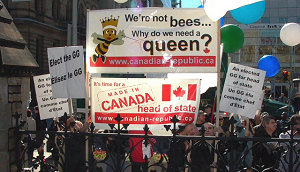 Republicanism in Canada
Republicanism in Canada or Canadian Republicanism is a movement for the replacement of the monarchy of Canada and a monarch as head of state with a parliamentary republic and a democratically selected Canadian as head of state. Republicans are driven by various factors, such as a perception of inequality in the concept of excluding all but members of the roy
-
 Republic of Upper Canada
The Republic of Upper Canada was a short-lived state proclaimed by William Lyon Mackenzie on December 13, 1837. It collapsed a month later on January 14, 1838. The self-proclaimed provisional government was established on Navy Island in the Niagara River during the Upper Canada Rebellion, part of the Rebellions of 1837–1838. It intended to usurp the colonial
Resolution source
This market settles from the official outcome published at https://www.fifa.com. A proposer submits the final result to the UMA optimistic oracle on Polygon; the two-hour dispute window closes and payouts clear in USDC.
How to trade this market step by step
The mechanics for trading "Canada vs. Republic of Ireland - More Markets" are the same as any other PolyGram event contract. Each YES share resolves to $1 if the event happens, or $0 if it doesn't. The current price between 0¢ and 100¢ is the market's probability estimate, set live by the order book.
- Sign in on polygram.ink with your email — no full KYC under $1,500 lifetime trading volume.
- Deposit USDC on Polygon (lowest fees, ~$0.01 per transaction) or Ethereum. Funds credit after 12 confirmations.
- Pick a side. Buy YES if you believe the event will happen; buy NO if you think it won't. The current YES price reflects the market's collective probability.
- Size your position. If you stake 100 USDC at 50% YES, you'll receive shares that pay $200 if YES resolves true — a 100% gross return. If NO resolves, your shares are worth $0.
- Set risk controls (optional). Stop-loss, take-profit, and limit-order types all supported. Use the trade ticket's slippage box to cap your maximum entry price.
- Wait for resolution. When the event resolves on-chain via the UMA optimistic oracle, the winning side settles to 100¢ automatically and USDC hits your balance within seconds. Withdrawable to any wallet you control.
How active is this market?
$0 in lifetime turnover and $1K of resting liquidity puts this market in the below the median by volume for soccer contracts on PolyGram. Order-book depth is thin — large orders may need to be split across the book or executed as limit orders.
The market has been open for under a month — fresh enough that information asymmetry remains a real factor.
Higher-volume markets tend to have tighter spreads and faster price discovery — meaning the displayed YES/NO percentages are more likely to reflect the true crowd-implied probability rather than a single trader's directional view.
Key terms
- YES / NO share
- A binary outcome token that pays $1.00 if the underlying claim resolves true (YES) or false (NO), and $0 otherwise. The market price between 0¢ and 100¢ is the implied probability.
- CLOB
- Central limit order book. The matching engine that pairs YES buyers with NO buyers (effectively the same trade). Polymarket's CLOB on Polygon executes trades on-chain via the conditional-tokens framework.
- Liquidity
- USDC capital sitting in resting limit orders inside the order book. Deeper liquidity means smaller slippage on large trades and a tighter bid-ask spread.
- UMA optimistic oracle
- The on-chain dispute system that settles each Polymarket market. A proposer submits the outcome, a two-hour challenge window opens, and unchallenged proposals finalise the resolution.
- Slippage
- The difference between the displayed mid-price and your fill price. Affects market orders most; limit orders avoid slippage but may take time to fill.
- Conditional token
- ERC-1155 outcome share issued by Gnosis Conditional Tokens on Polygon. The token type that resolves to $1.00 or $0.00 at settlement.
Frequently asked questions
How does this market resolve?
Resolution is sourced from https://www.fifa.com. Settlement is executed by the UMA optimistic oracle on Polygon, with a 2-hour dispute window before payouts clear.
When does this market close?
This prediction market is scheduled to close on 5 June 2026. After the resolving event occurs, settlement typically clears within 24 hours once the UMA optimistic oracle confirms the outcome. All payouts are in USDC on the Polygon network.
How can I trade on "Canada vs. Republic of Ireland - More Markets"?
To trade on this prediction market, create a free PolyGram account at polygram.ink, deposit USDC via Polygon, and place a YES or NO order on the outcome you believe in. You can learn more on our how-it-works page. Your maximum loss is limited to your stake — there is no leverage or margin.
What happens when the market resolves?
When the outcome is determined, winning YES shares pay out $1.00 each in USDC, while losing shares pay $0. Settlement is handled by the UMA optimistic oracle on Polygon — a proposer submits the result, a two-hour dispute window opens, and if uncontested, payouts are distributed automatically. You can withdraw your winnings to any Polygon wallet.
Risk and regulatory note
Prediction-market positions can lose 100% of staked capital. Outcomes are uncertain by definition — historical accuracy of crowd-implied probabilities is high in aggregate but not for any single market. PolyGram does not provide investment advice. Trade only with capital you can afford to lose.
Regulatory status varies by jurisdiction. Germany, the United States, and most EU countries treat Polymarket-style event contracts under one of three frameworks: financial derivative, gambling product, or unregulated novel asset. Consult local counsel before trading.
Related prediction markets
Explore more prediction market odds and trading opportunities on PolyGram: