Trade: UEFA Champions League: Home country of champion
Resolution criteria on PolyGram: This market will resolve according to the home nation of the 2026 UEFA Champions League winner. If at any point it becomes impossible for any club from the listed country to win the UEFA Champions League (e.g. they are mathematically eliminated), the associated market will resolve to "No". If the 2026 UEFA Champions League is cancelled, postponed after June 10, 2026, 11:59 PM ET or the 2026 UEFA Champions League champion has not been declared within that timeframe, this market will resolve to “Other”. The resolution source for this market will be official information from the UEFA; however, a consensus of credible reporting may also be used.
PolyGram is an on-chain prediction market where you trade YES or NO outcome shares with real USDC on Polygon. For this market, buy YES if you believe the event will happen, or NO if you think it won't. Your maximum loss is your stake — winning shares pay $1.00 each at resolution. Unlike sportsbooks, there is no house edge: prices are set by supply and demand from other traders and reflect the crowd's real-time probability.
- Liquidity
- $78K
- Total Volume
- $87K
- 24h Volume
- $384
- Open Interest
- $10K
Market outcomes
| England | 43% YES | 57% NO |
| Italy | 0% YES | 100% NO |
| Turkey | 0% YES | 100% NO |
| Other | — | |
| Spain | 0% YES | 100% NO |
| Germany | 0% YES | 100% NO |
| France | 57% YES | 43% NO |
| Portugal | 0% YES | 100% NO |
Market context
The 2025–26 UEFA Champions League season will culminate in a final scheduled for June 2026, with the market assessing whether the champion club will be based in a specific country. The current order book on Polymarket implies a 43% probability, reflecting traders' collective assessment of that nation's competitive strength across its domestic league representatives in Europe's premier club competition.
Historically, Champions League winners have concentrated amongst clubs from five major leagues: Spain, England, Germany, Italy, and France. Spanish clubs have won the competition in 8 of the last 15 seasons (2010–2025), whilst English clubs have claimed 3 titles in that span. The probability distribution across nations typically correlates with domestic league strength, European coefficient rankings, and the financial capacity of clubs to retain elite talent. Current market pricing at 43% suggests traders are weighing the specified country's representation against this historical baseline and the competitive depth of rival nations.
The 2025–26 group stage draw, scheduled for August 2025, will determine fixture difficulty and qualification pathways that materially affect survival rates through the knockout rounds. Injury patterns amongst key players, managerial changes at major clubs, and mid-season transfer activity between January and February 2026 will provide concrete data points for reassessing probabilities. UEFA's fixture calendar and any potential fixture congestion affecting the specified nation's clubs during the spring knockout phase will also influence trading positions as the final approaches.
Wikipedia Context
-
 UEFA Champions League
The UEFA Champions League, commonly known as the Champions League, is an annual club association football competition organised by the Union of European Football Associations (UEFA) that is contested by top-division European clubs. The competition begins with a round robin league phase to qualify for the double-legged knockout rounds, and a single-leg final.
-
UEFA Champions League Anthem
The UEFA Champions League Anthem, officially titled as simply the "Champions League", is the official anthem of the UEFA Champions League, written by English composer Tony Britten in 1992, and based on George Frideric Handel's Zadok the Priest. It was also the official anthem of the UEFA Women's Champions League from its creation in 2001 to the 2021 creation
-
UEFA Champions League clubs performance comparison
The comparison of the performances of all the clubs that participated in the UEFA Champions League is presented below. The qualifying rounds are not taken into account.
-
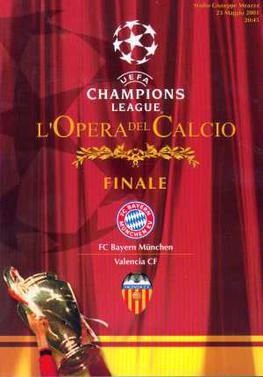 2001 UEFA Champions League final
The 2001 UEFA Champions League final was a football match that took place at San Siro in Milan, Italy, on 23 May 2001, to decide the winner of the 2000–01 UEFA Champions League. The match pitted German side Bayern Munich against Spanish side Valencia. The match finished in a 1–1 draw, but Bayern clinched their fourth title by winning 5–4 on penalties. This w
How this market resolves
Resolution is handled by the UMA optimistic oracle on Polygon. A proposer submits the outcome, a two-hour dispute window opens, and if no one stakes a counter-claim the payout is final. Contested outcomes escalate to UMA token-holder voting. Payouts clear in USDC to the winning side.
How to trade this market step by step
The mechanics for trading "UEFA Champions League: Home country of champion" are the same as any other PolyGram event contract. Each YES share resolves to $1 if the event happens, or $0 if it doesn't. The current price between 0¢ and 100¢ is the market's probability estimate, set live by the order book.
- Sign in on polygram.ink with your email — no full KYC under $1,500 lifetime trading volume.
- Deposit USDC on Polygon (lowest fees, ~$0.01 per transaction) or Ethereum. Funds credit after 12 confirmations.
- Pick a side. Buy YES if you believe the event will happen; buy NO if you think it won't. The current YES price reflects the market's collective probability.
- Size your position. If you stake 100 USDC at 50% YES, you'll receive shares that pay $200 if YES resolves true — a 100% gross return. If NO resolves, your shares are worth $0.
- Set risk controls (optional). Stop-loss, take-profit, and limit-order types all supported. Use the trade ticket's slippage box to cap your maximum entry price.
- Wait for resolution. When the event resolves on-chain via the UMA optimistic oracle, the winning side settles to 100¢ automatically and USDC hits your balance within seconds. Withdrawable to any wallet you control.
How active is this market?
$87K in lifetime turnover and $78K of resting liquidity puts this market in the above the median by volume for champions league contracts on PolyGram. Order-book depth is exceptional — among the deepest order books in the category.
Last 24 hours alone saw $384 in turnover, consistent with the market's lifetime daily-average pace.
The market has been open for 2 months — the price has had time to stabilise as new information arrived.
Higher-volume markets tend to have tighter spreads and faster price discovery — meaning the displayed YES/NO percentages are more likely to reflect the true crowd-implied probability rather than a single trader's directional view.
Key terms
- YES / NO share
- A binary outcome token that pays $1.00 if the underlying claim resolves true (YES) or false (NO), and $0 otherwise. The market price between 0¢ and 100¢ is the implied probability.
- CLOB
- Central limit order book. The matching engine that pairs YES buyers with NO buyers (effectively the same trade). Polymarket's CLOB on Polygon executes trades on-chain via the conditional-tokens framework.
- Liquidity
- USDC capital sitting in resting limit orders inside the order book. Deeper liquidity means smaller slippage on large trades and a tighter bid-ask spread.
- UMA optimistic oracle
- The on-chain dispute system that settles each Polymarket market. A proposer submits the outcome, a two-hour challenge window opens, and unchallenged proposals finalise the resolution.
- Slippage
- The difference between the displayed mid-price and your fill price. Affects market orders most; limit orders avoid slippage but may take time to fill.
- Conditional token
- ERC-1155 outcome share issued by Gnosis Conditional Tokens on Polygon. The token type that resolves to $1.00 or $0.00 at settlement.
Frequently asked questions
How does this market resolve?
Resolution is handled by the UMA optimistic oracle on Polygon. A proposer submits the outcome, a 2-hour dispute window opens, and if uncontested the payout is final. Contested outcomes escalate to UMA token holders.
When does this market close?
This prediction market is scheduled to close on 13 June 2026. After the resolving event occurs, settlement typically clears within 24 hours once the UMA optimistic oracle confirms the outcome. All payouts are in USDC on the Polygon network.
How can I trade on "UEFA Champions League: Home country of champion"?
To trade on this prediction market, create a free PolyGram account at polygram.ink, deposit USDC via Polygon, and place a YES or NO order on the outcome you believe in. You can learn more on our how-it-works page. Your maximum loss is limited to your stake — there is no leverage or margin.
What happens when the market resolves?
When the outcome is determined, winning YES shares pay out $1.00 each in USDC, while losing shares pay $0. Settlement is handled by the UMA optimistic oracle on Polygon — a proposer submits the result, a two-hour dispute window opens, and if uncontested, payouts are distributed automatically. You can withdraw your winnings to any Polygon wallet.
Risk and regulatory note
Prediction-market positions can lose 100% of staked capital. Outcomes are uncertain by definition — historical accuracy of crowd-implied probabilities is high in aggregate but not for any single market. PolyGram does not provide investment advice. Trade only with capital you can afford to lose.
Regulatory status varies by jurisdiction. Germany, the United States, and most EU countries treat Polymarket-style event contracts under one of three frameworks: financial derivative, gambling product, or unregulated novel asset. Consult local counsel before trading.
Related prediction markets
Explore more prediction market odds and trading opportunities on PolyGram: