Trade: Kevin Warsh cuts rates at first Fed meeting?
Resolution criteria on PolyGram: The Fed interest rates are defined in this market by the upper bound of the target federal funds range. The decisions on the target federal funds range are made by the Federal Open Market Committee (FOMC) meetings. This market will resolve to “Yes” if the Fed decreases the upper bound of the target federal funds range as a result of the first FOMC Meeting for which Kevin Warsh holds the position of Chair of the Federal Reserve. Otherwise, this market will resolve to "No" The resolution source for this market is the FOMC’s statement after the first FOMC Meeting for which Kevin Warsh holds the position of Chair of the Federal Reserve.
PolyGram is an on-chain prediction market where you trade YES or NO outcome shares with real USDC on Polygon. For this market, buy YES if you believe the event will happen, or NO if you think it won't. Your maximum loss is your stake — winning shares pay $1.00 each at resolution. Unlike sportsbooks, there is no house edge: prices are set by supply and demand from other traders and reflect the crowd's real-time probability.
- Liquidity
- $15K
- Total Volume
- $6K
- 24h Volume
- —
- Open Interest
- $3K
Market outcomes
| Kevin Warsh cuts rates at first Fed meeting? | 4% YES | 96% NO |
Market context
Kevin Warsh would need to be confirmed as Federal Reserve Chair and then cut rates at his first FOMC meeting. The current 4% implied probability on Polymarket's order book reflects the substantial hurdles required: Warsh must first be nominated and confirmed by the Senate, then preside over an FOMC meeting where a rate cut occurs. The Fed has held rates in the 5.25–5.50% range since July 2023, and recent inflation data has remained sticky, making immediate cuts unlikely regardless of leadership.
Historical precedent suggests incoming Fed chairs rarely engineer rate cuts at their debut meeting. Jerome Powell's first FOMC decision in February 2018 maintained rates; Janet Yellen held steady in February 2014. Rate cuts typically follow months of economic deterioration or explicit policy shifts signalled well in advance. Warsh's public statements have emphasised data-dependence and gradual adjustment rather than aggressive easing, which aligns with conventional Fed practice but argues against a surprise cut at his opening meeting.
The timeline depends on Senate confirmation proceedings and the FOMC calendar. If confirmed in early 2025, Warsh's first meeting could occur in March or May. Traders monitoring this contract should track inflation reports, employment data, and any recession signals between now and that meeting, as these would be the primary drivers of actual rate decisions. Warsh's confirmation hearing statements and any pre-meeting communications will also signal his initial policy stance. The 4% probability reflects the base case that incoming chairs maintain continuity rather than disrupt established policy immediately.
Wikipedia Context
-
 Kevin Warsh
Kevin Maxwell Warsh is an American financier and attorney who served as a member of the Federal Reserve Board of Governors from 2006 to 2011.
-
 Kevin Warwick
Kevin Warwick is an English engineer and Deputy Vice-Chancellor (Research) at Coventry University. He is known for his studies on direct interfaces between computer systems and the human nervous system, and has also done research concerning robotics.
-
 Kevin Nash
Kevin Scott Nash is an American retired professional wrestler, actor and podcaster. He is signed to WWE under a legends contract. He is also known for his tenures in World Championship Wrestling (WCW) and Total Nonstop Action Wrestling (TNA).
-
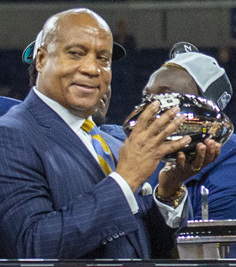 Kevin Warren
Kevin Fulbright Warren is an American attorney and sports executive. He is the team president and chief executive officer (CEO) for the Chicago Bears of the National Football League (NFL). He was previously the commissioner of the Big Ten Conference from 2020 to 2023, overseeing negotiations for expansion of the conference.
How this market resolves
Resolution is handled by the UMA optimistic oracle on Polygon. A proposer submits the outcome, a two-hour dispute window opens, and if no one stakes a counter-claim the payout is final. Contested outcomes escalate to UMA token-holder voting. Payouts clear in USDC to the winning side.
How to trade this market step by step
The mechanics for trading "Kevin Warsh cuts rates at first Fed meeting?" are the same as any other PolyGram event contract. Each YES share resolves to $1 if the event happens, or $0 if it doesn't. The current price between 0¢ and 100¢ is the market's probability estimate, set live by the order book.
- Sign in on polygram.ink with your email — no full KYC under $1,500 lifetime trading volume.
- Deposit USDC on Polygon (lowest fees, ~$0.01 per transaction) or Ethereum. Funds credit after 12 confirmations.
- Pick a side. Buy YES if you believe the event will happen; buy NO if you think it won't. The current YES price reflects the market's collective probability.
- Size your position. If you stake 100 USDC at 4% YES, you'll receive shares that pay $2500 if YES resolves true — a 2400% gross return. If NO resolves, your shares are worth $0.
- Set risk controls (optional). Stop-loss, take-profit, and limit-order types all supported. Use the trade ticket's slippage box to cap your maximum entry price.
- Wait for resolution. When the event resolves on-chain via the UMA optimistic oracle, the winning side settles to 100¢ automatically and USDC hits your balance within seconds. Withdrawable to any wallet you control.
How active is this market?
$6K in lifetime turnover and $15K of resting liquidity puts this market in the below the median by volume for trump contracts on PolyGram. Order-book depth is modest — expect a couple of cents of slippage on $1k+ trades.
The market has been open for under a month — fresh enough that information asymmetry remains a real factor.
Higher-volume markets tend to have tighter spreads and faster price discovery — meaning the displayed YES/NO percentages are more likely to reflect the true crowd-implied probability rather than a single trader's directional view.
Key terms
- YES / NO share
- A binary outcome token that pays $1.00 if the underlying claim resolves true (YES) or false (NO), and $0 otherwise. The market price between 0¢ and 100¢ is the implied probability.
- CLOB
- Central limit order book. The matching engine that pairs YES buyers with NO buyers (effectively the same trade). Polymarket's CLOB on Polygon executes trades on-chain via the conditional-tokens framework.
- Liquidity
- USDC capital sitting in resting limit orders inside the order book. Deeper liquidity means smaller slippage on large trades and a tighter bid-ask spread.
- UMA optimistic oracle
- The on-chain dispute system that settles each Polymarket market. A proposer submits the outcome, a two-hour challenge window opens, and unchallenged proposals finalise the resolution.
- Slippage
- The difference between the displayed mid-price and your fill price. Affects market orders most; limit orders avoid slippage but may take time to fill.
- Conditional token
- ERC-1155 outcome share issued by Gnosis Conditional Tokens on Polygon. The token type that resolves to $1.00 or $0.00 at settlement.
Frequently asked questions
What is the current probability for "Kevin Warsh cuts rates at first Fed meeting?"?
As of today, traders on Polymarket price this outcome at 4%. The number updates continuously as the order book clears. PolyGram mirrors the same live odds with locale-aware formatting and USDC settlement.
How does this market resolve?
Resolution is handled by the UMA optimistic oracle on Polygon. A proposer submits the outcome, a 2-hour dispute window opens, and if uncontested the payout is final. Contested outcomes escalate to UMA token holders.
How can I trade on "Kevin Warsh cuts rates at first Fed meeting?"?
To trade on this prediction market, create a free PolyGram account at polygram.ink, deposit USDC via Polygon, and place a YES or NO order on the outcome you believe in. You can learn more on our how-it-works page. Your maximum loss is limited to your stake — there is no leverage or margin.
What happens when the market resolves?
When the outcome is determined, winning YES shares pay out $1.00 each in USDC, while losing shares pay $0. Settlement is handled by the UMA optimistic oracle on Polygon — a proposer submits the result, a two-hour dispute window opens, and if uncontested, payouts are distributed automatically. You can withdraw your winnings to any Polygon wallet.
Risk and regulatory note
Prediction-market positions can lose 100% of staked capital. Outcomes are uncertain by definition — historical accuracy of crowd-implied probabilities is high in aggregate but not for any single market. PolyGram does not provide investment advice. Trade only with capital you can afford to lose.
Regulatory status varies by jurisdiction. Germany, the United States, and most EU countries treat Polymarket-style event contracts under one of three frameworks: financial derivative, gambling product, or unregulated novel asset. Consult local counsel before trading.
Related prediction markets
Explore more prediction market odds and trading opportunities on PolyGram: