Trade: Who will be cast on Dancing With the Stars: Season 35?
Resolution criteria on PolyGram: Dancing with the Stars is a reality dance competition in which celebrities are paired with professional dancers to perform dance routines. This market will resolve to "Yes" if the listed individual is announced as a contestant on Dancing With the Stars: Season 35. Otherwise, this market will resolve to "No". If the listed individual is not announced as a contestant by the end of the first episode of Dancing With the Stars: Season 35, this market will resolve to "No". This market will resolve based on the first qualifying announcement, regardless of whether an announced contestant is later dropped from the cast.
PolyGram is an on-chain prediction market where you trade YES or NO outcome shares with real USDC on Polygon. For this market, buy YES if you believe the event will happen, or NO if you think it won't. Your maximum loss is your stake — winning shares pay $1.00 each at resolution. Unlike sportsbooks, there is no house edge: prices are set by supply and demand from other traders and reflect the crowd's real-time probability.
- Liquidity
- $16
- Total Volume
- $8
- 24h Volume
- —
- Open Interest
- $3
Market outcomes
| Rob Rausch | 51% YES | 49% NO |
| Miranda McWhorter | 43% YES | 57% NO |
| Ashtin Earle | 50% YES | 50% NO |
Market context
Dancing with the Stars Season 35 will feature a new cohort of celebrity contestants paired with professional dancers for the upcoming broadcast cycle. The show's casting announcements typically occur in the weeks preceding the season premiere, with ABC releasing the full contestant roster through official channels and media appearances. The current order book on Polymarket implies a 51% probability that a specific individual will be among those announced, reflecting genuine uncertainty about the final casting decisions.
Historical casting patterns for DWTS demonstrate significant variability in contestant selection, with producers balancing A-list recognition against dance potential and narrative appeal. Previous seasons have featured athletes, actors, musicians, and television personalities across a wide demographic range. The show's casting process remains opaque, with producers occasionally surprising audiences with unexpected choices whilst sometimes failing to secure rumoured targets. This unpredictability has historically kept implied probabilities for individual contestants within a moderate range, rarely exceeding 70% or falling below 30% for serious contenders.
Traders should monitor ABC's official announcements and entertainment news outlets for casting confirmations, which typically emerge between late August and early September for autumn premieres. The settlement window extends to March 2027, providing substantial time for announcements to occur. Key dependencies include the individual's availability, their public profile trajectory, and any competing commitments. Recent entertainment reporting suggests casting discussions are ongoing, though no comprehensive roster has been publicly confirmed. The first episode air date will trigger resolution, making early-season premiere scheduling announcements critical catalysts for market movement.
Wikipedia Context
-
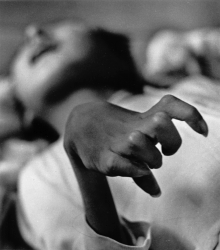 Minamata disease
Minamata disease is a neurological disease caused by severe mercury poisoning. Symptoms include ataxia, numbness in the hands and feet, general muscle weakness, loss of peripheral vision, and damage to hearing and speech. In extreme cases, insanity, paralysis, coma, and death follow within weeks of the onset of symptoms. A form of the disease in babies, wit
-
 Go-go dancing
Go-go dancers are dancers who are employed to entertain crowds at nightclubs or other venues where music is played. Go-go dancing originated in the early 1960s at the French bar Whisky a Gogo, located in the town of Juan-les-Pins. The French bar then licensed its name to the West Hollywood rock club Whisky a Go Go, which opened in January 1964 and chose the
-
 Caller (dancing)
A caller is a person who prompts dance figures in such dances as line dance, square dance, and contra dance. The caller might be one of the participating dancers, though in modern country dance this is rare.
How this market resolves
Resolution is handled by the UMA optimistic oracle on Polygon. A proposer submits the outcome, a two-hour dispute window opens, and if no one stakes a counter-claim the payout is final. Contested outcomes escalate to UMA token-holder voting. Payouts clear in USDC to the winning side.
How to trade this market step by step
The mechanics for trading "Who will be cast on Dancing With the Stars: Season 35?" are the same as any other PolyGram event contract. Each YES share resolves to $1 if the event happens, or $0 if it doesn't. The current price between 0¢ and 100¢ is the market's probability estimate, set live by the order book.
- Sign in on polygram.ink with your email — no full KYC under $1,500 lifetime trading volume.
- Deposit USDC on Polygon (lowest fees, ~$0.01 per transaction) or Ethereum. Funds credit after 12 confirmations.
- Pick a side. Buy YES if you believe the event will happen; buy NO if you think it won't. The current YES price reflects the market's collective probability.
- Size your position. If you stake 100 USDC at 50% YES, you'll receive shares that pay $200 if YES resolves true — a 100% gross return. If NO resolves, your shares are worth $0.
- Set risk controls (optional). Stop-loss, take-profit, and limit-order types all supported. Use the trade ticket's slippage box to cap your maximum entry price.
- Wait for resolution. When the event resolves on-chain via the UMA optimistic oracle, the winning side settles to 100¢ automatically and USDC hits your balance within seconds. Withdrawable to any wallet you control.
How active is this market?
$8 in lifetime turnover and $16 of resting liquidity puts this market in the below the median by volume for pop culture contracts on PolyGram. Order-book depth is thin — large orders may need to be split across the book or executed as limit orders.
The market has been open for under a month — fresh enough that information asymmetry remains a real factor.
Higher-volume markets tend to have tighter spreads and faster price discovery — meaning the displayed YES/NO percentages are more likely to reflect the true crowd-implied probability rather than a single trader's directional view.
Key terms
- YES / NO share
- A binary outcome token that pays $1.00 if the underlying claim resolves true (YES) or false (NO), and $0 otherwise. The market price between 0¢ and 100¢ is the implied probability.
- CLOB
- Central limit order book. The matching engine that pairs YES buyers with NO buyers (effectively the same trade). Polymarket's CLOB on Polygon executes trades on-chain via the conditional-tokens framework.
- Liquidity
- USDC capital sitting in resting limit orders inside the order book. Deeper liquidity means smaller slippage on large trades and a tighter bid-ask spread.
- UMA optimistic oracle
- The on-chain dispute system that settles each Polymarket market. A proposer submits the outcome, a two-hour challenge window opens, and unchallenged proposals finalise the resolution.
- Slippage
- The difference between the displayed mid-price and your fill price. Affects market orders most; limit orders avoid slippage but may take time to fill.
- Conditional token
- ERC-1155 outcome share issued by Gnosis Conditional Tokens on Polygon. The token type that resolves to $1.00 or $0.00 at settlement.
Frequently asked questions
How does this market resolve?
Resolution is handled by the UMA optimistic oracle on Polygon. A proposer submits the outcome, a 2-hour dispute window opens, and if uncontested the payout is final. Contested outcomes escalate to UMA token holders.
When does this market close?
This prediction market is scheduled to close on 31 March 2027. After the resolving event occurs, settlement typically clears within 24 hours once the UMA optimistic oracle confirms the outcome. All payouts are in USDC on the Polygon network.
How can I trade on "Who will be cast on Dancing With the Stars: Season 35?"?
To trade on this prediction market, create a free PolyGram account at polygram.ink, deposit USDC via Polygon, and place a YES or NO order on the outcome you believe in. You can learn more on our how-it-works page. Your maximum loss is limited to your stake — there is no leverage or margin.
What happens when the market resolves?
When the outcome is determined, winning YES shares pay out $1.00 each in USDC, while losing shares pay $0. Settlement is handled by the UMA optimistic oracle on Polygon — a proposer submits the result, a two-hour dispute window opens, and if uncontested, payouts are distributed automatically. You can withdraw your winnings to any Polygon wallet.
Risk and regulatory note
Prediction-market positions can lose 100% of staked capital. Outcomes are uncertain by definition — historical accuracy of crowd-implied probabilities is high in aggregate but not for any single market. PolyGram does not provide investment advice. Trade only with capital you can afford to lose.
Regulatory status varies by jurisdiction. Germany, the United States, and most EU countries treat Polymarket-style event contracts under one of three frameworks: financial derivative, gambling product, or unregulated novel asset. Consult local counsel before trading.
Related prediction markets
Explore more prediction market odds and trading opportunities on PolyGram: