Trade: Supreme Court rules in favor of Trump's tariffs?
Resolution criteria on PolyGram: This market will resolve to "Yes" if the Supreme Court of the United States issues a decision that reverses, vacates, or otherwise overturns the U.S. Court of Appeals for the Federal Circuit’s August 29, 2025 decision in V.O.S. Selections, Inc. v. Trump, in which the Federal Circuit held that the tariffs imposed by Executive Orders 14193, 14194, 14195, 14257, and 14266 exceeded the President’s authority under the International Emergency Economic Powers Act (IEEPA) by December 2026, 11:59 PM ET.
PolyGram is an on-chain prediction market where you trade YES or NO outcome shares with real USDC on Polygon. For this market, buy YES if you believe the event will happen, or NO if you think it won't. Your maximum loss is your stake — winning shares pay $1.00 each at resolution. Unlike sportsbooks, there is no house edge: prices are set by supply and demand from other traders and reflect the crowd's real-time probability.
- Liquidity
- —
- Total Volume
- $4.8M
- 24h Volume
- —
- Open Interest
- $0
Market outcomes
| Supreme Court rules in favor of Trump's tariffs? | 0% YES | 100% NO |
Market context
In August 2025, the U.S. Court of Appeals for the Federal Circuit ruled that tariffs imposed under five executive orders exceeded presidential authority under the International Emergency Economic Powers Act. The Supreme Court's potential review of this decision will determine whether the Federal Circuit's constraints on executive tariff-setting power stand or whether the administration's legal theory prevails. The market settles affirmatively only if the Supreme Court reverses, vacates, or otherwise overturns the Federal Circuit's decision by end of 2026.
The 0% implied probability on Polymarket's order book reflects substantial scepticism about Supreme Court reversal. Historical precedent suggests courts have been cautious about expansive readings of IEEPA authority, though the Supreme Court has occasionally deferred to executive claims in national security contexts. The Court's composition and recent administrative law decisions offer mixed signals: some justices favour broad executive power in foreign commerce, whilst others have shown willingness to constrain statutory overreach. The Federal Circuit's reasoning directly addressed statutory text and prior case law, creating a higher bar for reversal than a close appellate call.
Key catalysts include whether the Supreme Court grants certiorari—no petition filing date has been publicly announced as of early 2025. If cert is granted, oral arguments typically occur within six to nine months, with decisions following several months later. The December 2026 deadline leaves limited runway for a full Supreme Court cycle if the case has not yet been docketed. Any signals from the Court regarding case acceptance, combined with developments in related trade litigation, could shift trader positioning materially from current levels.
Wikipedia Context
-
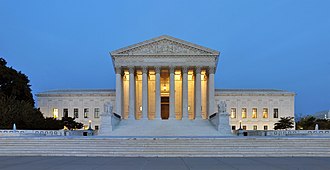 Supreme court
In most legal jurisdictions, a supreme court, also known as a court of last resort, apex court, high court of appeal, and court of final appeal, is the highest court within the hierarchy of courts. Broadly speaking, the decisions of a supreme court are binding on all other courts in a nation and are not subject to further review by any other court. Supreme c
-
 Supreme Court of the United States
The Supreme Court of the United States (SCOTUS) is the highest court in the federal judiciary of the United States. It has ultimate appellate jurisdiction over all U.S. federal court cases, and over state court cases that turn on questions of U.S. constitutional or federal law. It also has original jurisdiction over a narrow range of cases, specifically "all
-
 Supreme Court of India
The Supreme Court of India is the supreme judicial authority and the highest court in India. It is the highest appellate court for all civil and criminal cases in India. The court is led by the Chief Justice of India and has a maximum sanctioned strength of 33 judges excluding the chief justice. It was established on 28 January 1950, two days after India bec
-
 Supreme Court of Virginia
The Supreme Court of Virginia is the highest court in the Commonwealth of Virginia. It primarily hears direct appeals in civil cases from the trial-level city and county circuit courts, as well as the criminal law, family law and administrative law cases that are initially appealed to the Court of Appeals of Virginia. Established in 1779 as the Supreme Court
How this market resolves
Resolution is handled by the UMA optimistic oracle on Polygon. A proposer submits the outcome, a two-hour dispute window opens, and if no one stakes a counter-claim the payout is final. Contested outcomes escalate to UMA token-holder voting. Payouts clear in USDC to the winning side.
How to trade this market step by step
The mechanics for trading "Supreme Court rules in favor of Trump's tariffs?" are the same as any other PolyGram event contract. Each YES share resolves to $1 if the event happens, or $0 if it doesn't. The current price between 0¢ and 100¢ is the market's probability estimate, set live by the order book.
- Sign in on polygram.ink with your email — no full KYC under $1,500 lifetime trading volume.
- Deposit USDC on Polygon (lowest fees, ~$0.01 per transaction) or Ethereum. Funds credit after 12 confirmations.
- Pick a side. Buy YES if you believe the event will happen; buy NO if you think it won't. The current YES price reflects the market's collective probability.
- Size your position. If you stake 100 USDC at 0% YES, you'll receive shares that pay $200 if YES resolves true — a 100% gross return. If NO resolves, your shares are worth $0.
- Set risk controls (optional). Stop-loss, take-profit, and limit-order types all supported. Use the trade ticket's slippage box to cap your maximum entry price.
- Wait for resolution. When the event resolves on-chain via the UMA optimistic oracle, the winning side settles to 100¢ automatically and USDC hits your balance within seconds. Withdrawable to any wallet you control.
How active is this market?
$4.8M in lifetime turnover and $0 of resting liquidity puts this market in the top 2% by volume for courts contracts on PolyGram. Order-book depth is thin — large orders may need to be split across the book or executed as limit orders.
The market has been open for 8 months — long enough that the order book is mature and price is well-anchored to fundamentals.
Higher-volume markets tend to have tighter spreads and faster price discovery — meaning the displayed YES/NO percentages are more likely to reflect the true crowd-implied probability rather than a single trader's directional view.
Key terms
- YES / NO share
- A binary outcome token that pays $1.00 if the underlying claim resolves true (YES) or false (NO), and $0 otherwise. The market price between 0¢ and 100¢ is the implied probability.
- CLOB
- Central limit order book. The matching engine that pairs YES buyers with NO buyers (effectively the same trade). Polymarket's CLOB on Polygon executes trades on-chain via the conditional-tokens framework.
- Liquidity
- USDC capital sitting in resting limit orders inside the order book. Deeper liquidity means smaller slippage on large trades and a tighter bid-ask spread.
- UMA optimistic oracle
- The on-chain dispute system that settles each Polymarket market. A proposer submits the outcome, a two-hour challenge window opens, and unchallenged proposals finalise the resolution.
- Slippage
- The difference between the displayed mid-price and your fill price. Affects market orders most; limit orders avoid slippage but may take time to fill.
- Conditional token
- ERC-1155 outcome share issued by Gnosis Conditional Tokens on Polygon. The token type that resolves to $1.00 or $0.00 at settlement.
Frequently asked questions
What is the current probability for "Supreme Court rules in favor of Trump's tariffs?"?
As of today, traders on Polymarket price this outcome at 0%. The number updates continuously as the order book clears. PolyGram mirrors the same live odds with locale-aware formatting and USDC settlement.
How does this market resolve?
Resolution is handled by the UMA optimistic oracle on Polygon. A proposer submits the outcome, a 2-hour dispute window opens, and if uncontested the payout is final. Contested outcomes escalate to UMA token holders.
When does this market close?
This prediction market is scheduled to close on 31 December 2026. After the resolving event occurs, settlement typically clears within 24 hours once the UMA optimistic oracle confirms the outcome. All payouts are in USDC on the Polygon network.
How can I trade on "Supreme Court rules in favor of Trump's tariffs?"?
To trade on this prediction market, create a free PolyGram account at polygram.ink, deposit USDC via Polygon, and place a YES or NO order on the outcome you believe in. You can learn more on our how-it-works page. Your maximum loss is limited to your stake — there is no leverage or margin.
What happens when the market resolves?
When the outcome is determined, winning YES shares pay out $1.00 each in USDC, while losing shares pay $0. Settlement is handled by the UMA optimistic oracle on Polygon — a proposer submits the result, a two-hour dispute window opens, and if uncontested, payouts are distributed automatically. You can withdraw your winnings to any Polygon wallet.
Risk and regulatory note
Prediction-market positions can lose 100% of staked capital. Outcomes are uncertain by definition — historical accuracy of crowd-implied probabilities is high in aggregate but not for any single market. PolyGram does not provide investment advice. Trade only with capital you can afford to lose.
Regulatory status varies by jurisdiction. Germany, the United States, and most EU countries treat Polymarket-style event contracts under one of three frameworks: financial derivative, gambling product, or unregulated novel asset. Consult local counsel before trading.
Related prediction markets
Explore more prediction market odds and trading opportunities on PolyGram: