Trade: Canadian Grand Prix: Sprint Qualifying Pole Winner
Resolution criteria on PolyGram: This is a polymarket on the driver who achieves pole position in the Sprint Qualifying at the 2026 F1 Canadian Grand Prix, scheduled for May 22, 2026. If the 2026 F1 Canadian Grand Prix is canceled or rescheduled to a date after May 29, 2026, this market will resolve to “Other.” This market will resolve in favor of the driver who is officially recognized by Formula 1 as having set the fastest time during the Sprint Qualifying session for the 2026 F1 Canadian Grand Prix. The market will be settled based on the FIA's official qualifying results, regardless of any subsequent penalties, disqualifications, or changes to the starting grid.
PolyGram is an on-chain prediction market where you trade YES or NO outcome shares with real USDC on Polygon. For this market, buy YES if you believe the event will happen, or NO if you think it won't. Your maximum loss is your stake — winning shares pay $1.00 each at resolution. Unlike sportsbooks, there is no house edge: prices are set by supply and demand from other traders and reflect the crowd's real-time probability.
- Liquidity
- $29K
- Total Volume
- $14K
- 24h Volume
- $600
- Open Interest
- $3K
Market outcomes
| Pierre Gasly | 0% YES | 100% NO |
| Fernando Alonso | 0% YES | 100% NO |
| Alexander Albon | 0% YES | 100% NO |
| Gabriel Bortoleto | 1% YES | 99% NO |
| Sergio Perez | 0% YES | 100% NO |
| Charles Leclerc | 11% YES | 89% NO |
| Esteban Ocon | 3% YES | 97% NO |
| Lando Norris | 25% YES | 76% NO |
Market context
The 2026 Formula 1 Canadian Grand Prix will feature a sprint qualifying session on 22 May at the Circuit Gilles Villeneuve in Montreal, with pole position determined by the fastest single lap in that session. The current order book on Polymarket reflects a 1% implied probability, suggesting traders view this outcome as highly unlikely given present information. Settlement occurs on 29 May, providing a narrow window between the event and resolution; should the race be cancelled or postponed beyond that date, the market resolves to "Other."
Sprint qualifying formats have been contested at select F1 venues since 2021, with pole positions typically determined by the driver with the strongest single-lap pace under those specific conditions. Historical data shows sprint pole outcomes often diverge from main qualifying results, as drivers employ different tyre strategies and fuel loads. The Montreal circuit's technical layout—featuring tight corners and limited overtaking—means qualifying performance carries particular weight. Current probability levels suggest the market is pricing in either a specific driver's dominance or uncertainty about the format's application at this venue in 2026.
Key catalysts include confirmation of the 2026 calendar and any technical regulation changes affecting qualifying procedures, which the FIA typically announces in advance of the season. Team performance data from pre-season testing and early-season races will inform trader positioning as May approaches. Weather conditions at Montreal—historically variable in late May—could influence qualifying outcomes, though this remains unpredictable at present. Any driver injuries, mechanical failures, or grid penalties announced closer to the event date may shift market probabilities materially.
Wikipedia Context
-
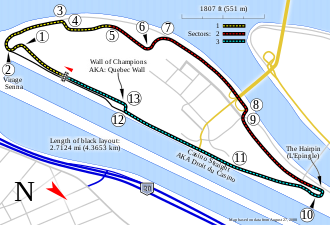 Canadian Grand Prix
The Canadian Grand Prix is an annual motor racing event held since 1961. It has been part of the Formula One World Championship since 1967. It was first staged at Mosport Park in Bowmanville, Ontario, as a sports car event, before alternating between Mosport and Circuit Mont-Tremblant, Quebec, after Formula One took over the event. After 1971, safety concern
-
Canadian Grand Masters
The Canadian Grand Masters is an annual event celebrating traditional fiddling in Canada. Considered "the pinnacle of Canadian fiddling," the core of the event is a concert/dance on Friday evening, followed by the competition the following day. Upwards of thirty contestants are selected to compete from across Canada, considered to be the top exceptional fidd
-
2017 Canadian Grand Prix
The 2017 Canadian Grand Prix was a Formula One motor race that took place on 11 June 2017 at the Circuit Gilles Villeneuve in Montreal, Quebec, Canada. The race was the seventh round of the 2017 FIA Formula One World Championship. It was the fifty-fourth running of the Canadian Grand Prix, and the forty-eighth time the event had been included as a round of t
-
 1997 Canadian Grand Prix
The 1997 Canadian Grand Prix was a Formula One motor race held at Circuit Gilles Villeneuve on 15 June 1997. The race was stopped early on lap 54 after a big crash involving Olivier Panis, who broke his legs and would be unable to start the next seven Grands Prix. Michael Schumacher won ahead of Jean Alesi in the Benetton and Giancarlo Fisichella in the Jord
Resolution source
This market settles from the official outcome published at https://www.formula1.com/en/results/2026/races. A proposer submits the final result to the UMA optimistic oracle on Polygon; the two-hour dispute window closes and payouts clear in USDC.
How to trade this market step by step
The mechanics for trading "Canadian Grand Prix: Sprint Qualifying Pole Winner" are the same as any other PolyGram event contract. Each YES share resolves to $1 if the event happens, or $0 if it doesn't. The current price between 0¢ and 100¢ is the market's probability estimate, set live by the order book.
- Sign in on polygram.ink with your email — no full KYC under $1,500 lifetime trading volume.
- Deposit USDC on Polygon (lowest fees, ~$0.01 per transaction) or Ethereum. Funds credit after 12 confirmations.
- Pick a side. Buy YES if you believe the event will happen; buy NO if you think it won't. The current YES price reflects the market's collective probability.
- Size your position. If you stake 100 USDC at 50% YES, you'll receive shares that pay $200 if YES resolves true — a 100% gross return. If NO resolves, your shares are worth $0.
- Set risk controls (optional). Stop-loss, take-profit, and limit-order types all supported. Use the trade ticket's slippage box to cap your maximum entry price.
- Wait for resolution. When the event resolves on-chain via the UMA optimistic oracle, the winning side settles to 100¢ automatically and USDC hits your balance within seconds. Withdrawable to any wallet you control.
How active is this market?
$14K in lifetime turnover and $29K of resting liquidity puts this market in the below the median by volume for formula1 contracts on PolyGram. Order-book depth is strong — order books support five-figure trades with single-cent slippage.
Last 24 hours alone saw $600 in turnover, consistent with the market's lifetime daily-average pace.
The market has been open for under a month — fresh enough that information asymmetry remains a real factor.
Higher-volume markets tend to have tighter spreads and faster price discovery — meaning the displayed YES/NO percentages are more likely to reflect the true crowd-implied probability rather than a single trader's directional view.
Key terms
- YES / NO share
- A binary outcome token that pays $1.00 if the underlying claim resolves true (YES) or false (NO), and $0 otherwise. The market price between 0¢ and 100¢ is the implied probability.
- CLOB
- Central limit order book. The matching engine that pairs YES buyers with NO buyers (effectively the same trade). Polymarket's CLOB on Polygon executes trades on-chain via the conditional-tokens framework.
- Liquidity
- USDC capital sitting in resting limit orders inside the order book. Deeper liquidity means smaller slippage on large trades and a tighter bid-ask spread.
- UMA optimistic oracle
- The on-chain dispute system that settles each Polymarket market. A proposer submits the outcome, a two-hour challenge window opens, and unchallenged proposals finalise the resolution.
- Slippage
- The difference between the displayed mid-price and your fill price. Affects market orders most; limit orders avoid slippage but may take time to fill.
- Conditional token
- ERC-1155 outcome share issued by Gnosis Conditional Tokens on Polygon. The token type that resolves to $1.00 or $0.00 at settlement.
Frequently asked questions
How does this market resolve?
Resolution is sourced from https://www.formula1.com/en/results/2026/races. Settlement is executed by the UMA optimistic oracle on Polygon, with a 2-hour dispute window before payouts clear.
When does this market close?
This prediction market is scheduled to close on 29 May 2026. After the resolving event occurs, settlement typically clears within 24 hours once the UMA optimistic oracle confirms the outcome. All payouts are in USDC on the Polygon network.
How can I trade on "Canadian Grand Prix: Sprint Qualifying Pole Winner"?
To trade on this prediction market, create a free PolyGram account at polygram.ink, deposit USDC via Polygon, and place a YES or NO order on the outcome you believe in. You can learn more on our how-it-works page. Your maximum loss is limited to your stake — there is no leverage or margin.
What happens when the market resolves?
When the outcome is determined, winning YES shares pay out $1.00 each in USDC, while losing shares pay $0. Settlement is handled by the UMA optimistic oracle on Polygon — a proposer submits the result, a two-hour dispute window opens, and if uncontested, payouts are distributed automatically. You can withdraw your winnings to any Polygon wallet.
Risk and regulatory note
Prediction-market positions can lose 100% of staked capital. Outcomes are uncertain by definition — historical accuracy of crowd-implied probabilities is high in aggregate but not for any single market. PolyGram does not provide investment advice. Trade only with capital you can afford to lose.
Regulatory status varies by jurisdiction. Germany, the United States, and most EU countries treat Polymarket-style event contracts under one of three frameworks: financial derivative, gambling product, or unregulated novel asset. Consult local counsel before trading.
Related prediction markets
Explore more prediction market odds and trading opportunities on PolyGram: